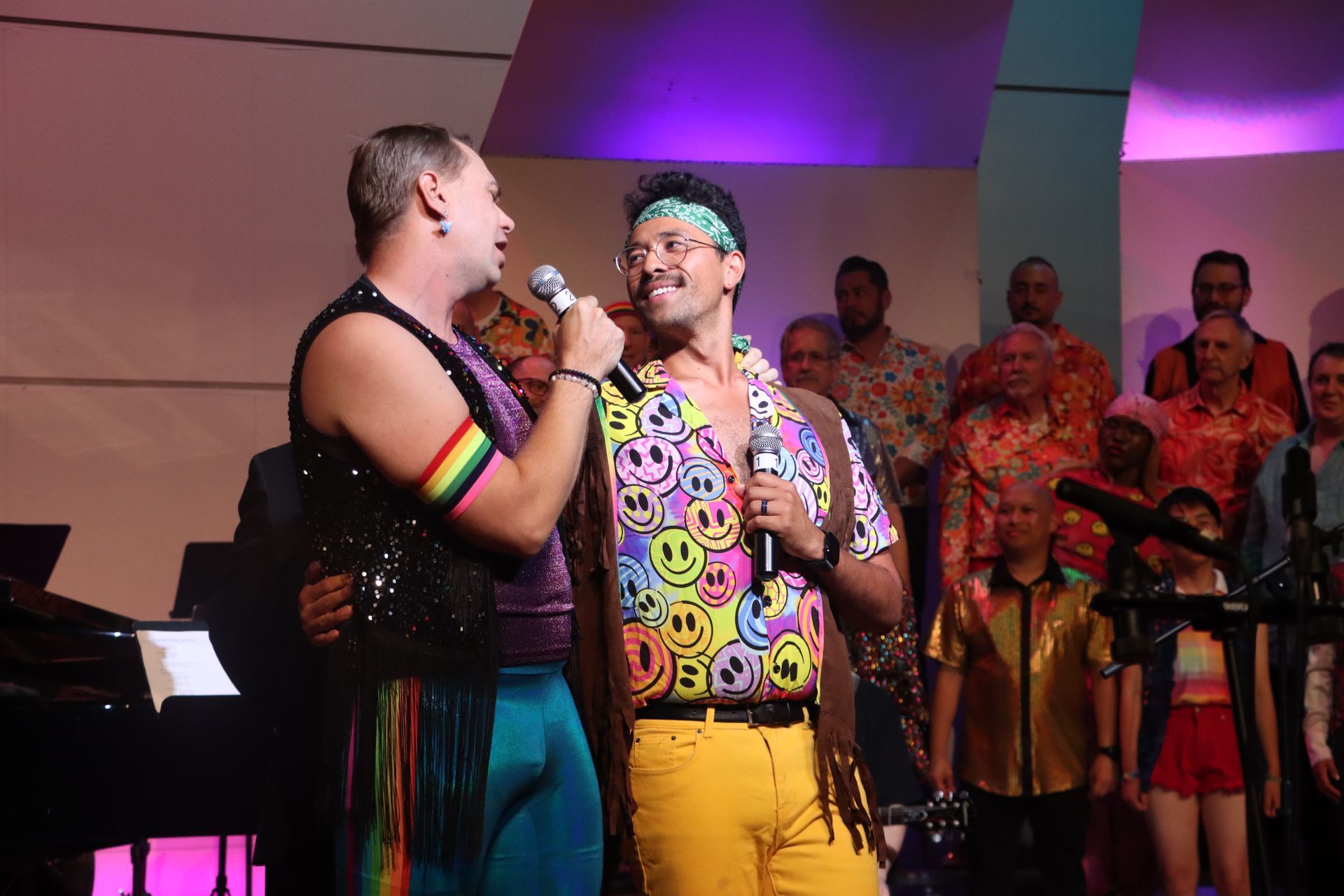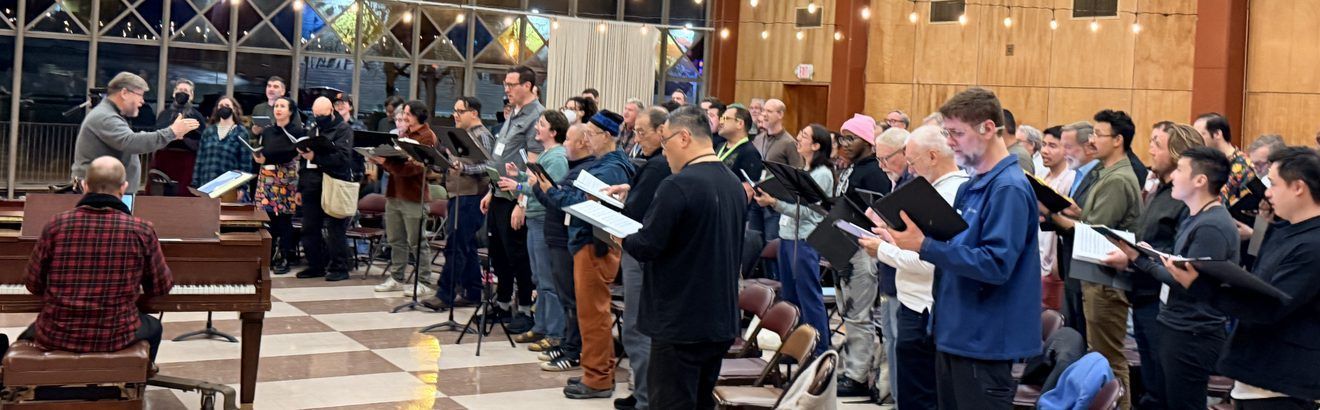


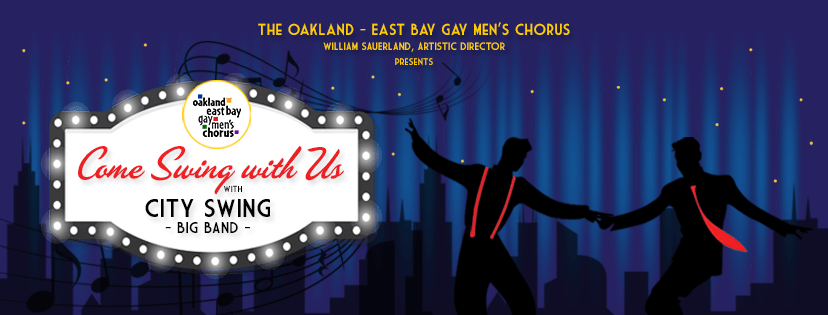
The Oakland-East Bay Gay Men’s Chorus is pairing with City Swing to perform a Concert of Swing right out of the Great American Song Book. So, what exactly is swing?
Swing is a quintessential 20 th century American sound, and it reflects all of our nation’s joy and struggle. Swing is inherently intertwined with class, race, the Great Depression, World War II, and the nostalgia that looked back to those eras in the later 20 th century. Swing itself rose out of the 1920s African-American jazz scene of New Orleans, which influenced the jazz scene in Chicago, and then the scene in New York City during the Harlem Renaissance of the ‘30s and ‘40s. Swing comes out of several styles, notably blending the more formal structure of syncopation found in ragtime (here is “ the Maple Leaf Rag ”, note how structured this is), and the improvised overlay of Dixieland, which has multiple soloists improvising together or in call and response with other sections; one of the most recognizable songs of Dixieland style is “ Oh When the Saints Go Marching In ” (Louis Armstrong performing a later version—note the multiple lines of melody, overlapping solos, and band sections including vocals playing off each other.)
Swing is recognizable by a strong downbeat in the drums and bass with a looser off-the-beat syncopation in the brass and woodwinds. Structured, written sections alternate with individual solos, which allows for a sometimes frenetic, sometimes chill sound. The most iconic of this style is, perhaps, Duke Ellingtons’ 1931 “ It Don’t Mean a Thing (If It Ain’t Got That Swing )”. This 1943 Duke Ellington Band version starts with a solo violin, then gets moving with on-the-beat left hand piano (later adds drums) and an off-beat syncopated melody in the right-hand piano, winds and vocals. It exemplifies that the written-out structured sections alternate with free-form solos including the vocalists. Often the formally written sections are intricate, harmonic, fast, and well-rehearsed. The lyric, “Makes no difference if it’s sweet or hot, just give that rhythm every little thing you’ve got,” alludes to the fact that swing is often described as “sweet” (more laid-back) or “hot” (more frenetic), and gives rise to dancing of both styles. Sweet Swing dancing (check out this 1946 “ Swing Dance ”), although employing rapid foot work and a body that is always in motion, uses more sway and more body connection than hot swing, which includes, jumps, kicks, running, and tossing your partner, as shown in this film version of “ Sing, Sing, Sing.”
With the back drop of the Great Depression and the US entry into WWII, Swing also represents the US’s long struggle with segregation and integration. Louis Armstrong, who was instrumental in moving New Orleans jazz to Chicago and then to New York, brought his solo trumpet style to the Fletcher Henderson Band, which is credited with experimenting with the specific Swing form in the ‘20s. Armstrong’s characteristic trumpet sound gave Big Bands the swing form of a structured written section that alternates with improvised solos. While Swing rises from the African-American Fletcher Henderson Band with Louis Armstrong, it was the white Benny Goodman’s weekly radio show that gave Swing wide public popularity and made Swing the sound of the ‘30s and ‘40s. Benny Goodman’s band was one of the first to integrate; Goodman employed Henderson to arrange and perform, and Goodman hired other African-Americans; yet many other band leaders, as well as the movie industry, theatres, and hotels had problems showing integrated bands.
Swing is the sound of travel by train, and notably, Glenn Miller’s “Chattanooga Choo-Choo”, which we are singing, reflects the implicit yet rarely acknowledged racial division of the era. In the era of Swing, southerners, mostly African-Americans, moved north and west, as the story of George Swanson Starling shows, in Isabel Wilkerson’s The Warmth of Other Suns: The Epic Story of America’s Great Migration , (NY: Vintage Books, 2010). George, who fled Florida because he angered the crop owners when he tied to unionize the citrus workers, moved to New York and became a railroad porter who travelled back and forth to the south. He tells of integrated train cars in the north and the regulations that required segregation at the Mason-Dixon line, meaning blacks had to all move to the front of the train. After President Johnson signed the Civil Rights Act in 1964, the trains were not to be segregated, yet the practice continued. George helped people understand their rights, even if it sometimes meant standing up to the violent dying gasps of the Jim Crow south. Chattanooga would have been below the line, yet this sweet Swing song barely acknowledges race; the lyrics, “Pardon me, boy,” and “Boy, you can give me a shine,” are understood as the racial epithet, “boy,” (We’ve changed the lyrics to “boys”, alluding to gay chorus members), but there is nothing else about segregation in the song.
Swing also took note of the new form of travel, flying, as in our version of “Come, Fly with Me.” That song marks the ease of travelling quickly somewhere, and the exhilaration of the being up with the birds. Compared to today’s extreme concern with security and over-packed airlines, the song seems incredibly naïve, when we sing the lyric, “just say the word and we’ll beat the birds down to Alcapulco Bay.”
Swing’s sweet naiveté is often balanced by it’s hot innuendos to sex or violence. As a subtle soundtrack to the issues of race and economics, offering joyful dance tunes into a period of violence, hunger, poverty and war, Swing and the iconic uniform of swingers, the zoot suit, was at the center of cultural wars. Cherry Poppin’ Daddies, in this 1997-written hot Swing number “ Zoot Suit Riot ”, refer to the Zoot Suit Riots of 1943, which pitted white servicemen against zoot-suit wearing Latinos, African-American and Filipino-Americans across the country.
The Swing sound is ubiquitous throughout the Great American Song Book, in movies, on the radio, and leading toward other genres. Swing, which lost some popularity after the war, was revived in the ‘50s and ‘60s by Sinatra, Nat King Cole, and other Rat Pack performers. Later orchestras like those of Ray Coniff (whose version of “On the Street Where You Live” we are singing) and Lawrence Welk, used the sweet sound of Swing in their big bands, adapting newer songs into the older swing form. Hot Swing had a nostalgic revival again in the ‘90s and early 2000’s with groups like the Big Bad Voodoo Daddies, Squirrel Nut Zippers, Brian Stetzer Orchestra (check out this 1999 version of “ Jump, Jive an’ Wail ”). More recently the Post-Modern Juke Box takes modern songs and makes them swing (check out this sweet Swing version of “ All About That Bass ”).
So what is Swing? Sweet, hot, American rhythm, syncopated, laid-back and off-the-beat, reflecting our racial struggles, a soundtrack to eras of financial struggle, and a nostalgic look at times when music hid all our troubles. Join us for this toe-tapping excursion.
Come Swing with Us!!!! July 15 & 16, 2017 at Oakland Asian Cultural Center, 338 Ninth St, Oakland CA.