


Brahms “A German Requiem”— The View from the Risers
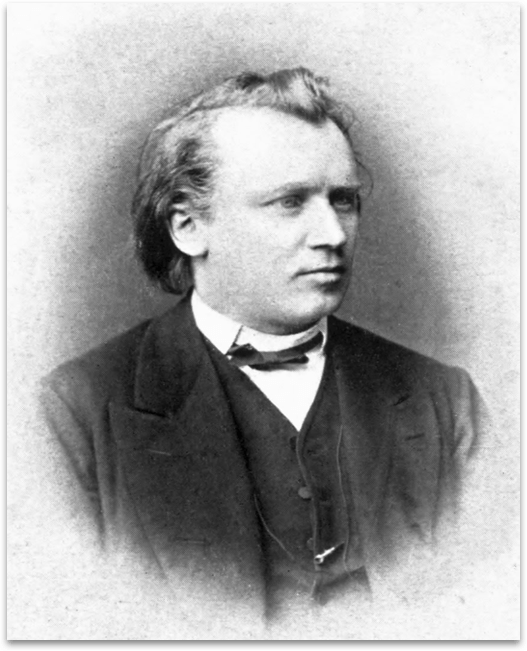
"Such a man, such a fine soul – and he believes in nothing! He believes in nothing !” So, wrote the deeply Catholic Antonín Dvořák in a letter, referring to his dear friend and mentor, Johannes Brahms. From the very beginning a lot of controversy about the German Requiem had to do with its lack of specific references to salvation through Christ. Jesus is never even mentioned in the verses Brahms chose from Luther’s Bible. He wrote "As far as the text is concerned, I confess that I would gladly omit even the word German and instead use Human; also, with my best knowledge and will, I would dispense with passages like John3:16. [‘For God so loved the world that he gave His only begotten Son…’] On the other hand, I have chosen one thing or another because I am a musician, because I needed it… But I had better stop before I say too much.”
At the age of 11, at his first solo piano recital, Brahms played a fugue by J. S. Bach. Even as a boy he was already fascinated by Baroque counterpoint. By that time “Old Bach” had been considered a pedantic drudge for generations. Everybody studied him, but nobody played him in concert.
The famous story goes that the 20-year-old Johannes showed up at the doorstep of Robert and Clara Schumann with a letter of introduction from the great violinist Joseph Joachim, played some of his own piano pieces for them, and forged an instant communion of four kindred souls that would endure until their deaths. Clara wrote in her diary that Brahms "seemed as if sent straight from God. “Robert (a noted critic as well as a composer) published an article about Brahms that launched his career, and seems to have planted a kind of terror in his young heart that he could never live up to all the hype. It only served to reinforce his natural perfectionist streak. After Robert’s attempted suicide in 1854 Brahms came to live with the Schumanns in Düsseldorf, where he dug into Robert’s extensive collection of early masters such as Bach, Heinrich Schütz, and Giovanni Gabrieli. Robert Schumann died in a mental institution two years later; these days he’d probably be diagnosed as bipolar. His death had a profound impact on Brahms. We can’t directly connect the Requiem to Schumann, but it certainly feels right.
We know from his letters that the idea of a Requiem in German had been stewing around in his mind for a while, then in February 1865 his mother died, and he started to write. He finished six movements by 1866, and added Movement V, with its lovely soprano solo, the following year. The German Requiem was his first big success, at the age of 33. He wouldn’t publish his First Symphony for another nine years.
As we noted, he chose scriptural verses from Luther’s Bible. We can tell something of his intentions in the first line of text, from the Beatitudes: “Selig sind, die da Leid tragen, denn sie sollen getröstet werden . ” (“Blessed are they that mourn, for they shall be comforted”) Contrast that with the opening words of the Latin Requiem Mass (so named for its first word): “Requiem eternam dona eis Domine, et lux perpetua luceat eis.” (“Eternal rest grant to them, O Lord, and perpetual light shine on them.”) The funeral Mass is focused on the loved one who has died. The German Requiem is focused on the living , on those left behind, on “they that mourn.”
As a singer, one of the first things you notice is that you never, ever get to sit down! The piece lasts about an hour and ten minutes. That’s a lot of standing. Usually in a big choral orchestral work, like any of the well-known Masses and Requiems, there are times you get to sit. The soprano has an aria, or the solo quartet sings the Benedictus . The German Requiem has beautiful solos for soprano and baritone, but all three of those solos include the chorus singing as well. In both of the two baritone solos the chorus completely takes over the movement, which in both instances end up in magnificent choral fugues. In a way, the chorus represents the body of mourners, and since the work is about the mourners, we’re never far from center stage. (By the way, both of the fugues are notated alla breve , with the half-note getting the beat. A nod to music of the distant past.)
The other thing any singer will tell you is that the German Requiem is challenging to sing, to say the least, and not just the fugues. Brahms combines Bach’s mastery of counterpoint with his own audacious harmonies, and a breathtaking sense of internal rhythm. The first performances in Britain, in 1876, received glowing reviews, but critics said that the music was beyond what the singers could manage. It was only after the London Bach Choir began singing it that the truth shone through: To sing the German Requiem well you need to train to sing Bach. They’re rooted the same soil.
The Oakland Gay Men’s Chorus has the great privilege of joining the Oakland Symphony Chorus and Orchestra, under maestro Michael Morgan, in a single performance of this towering masterpiece, at the Paramount Theater, on Friday, November 16th, in honor of those who lost their lives in the Ghost Ship fire, and in “chorus” with their survivors. We hope you’ll join us.