
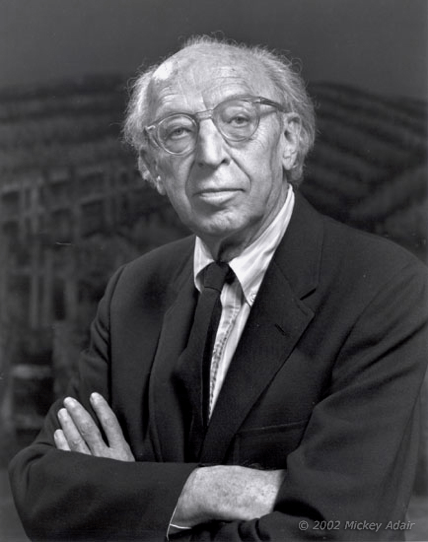
“You compose because you want to somehow summarize in some permanent form your most basic feelings about being alive, to set down... some sort of permanent statement about the way it feels to live now, today.”

“If a literary man puts together two words about music one of them will be wrong.”

“'Is there a meaning to music?' My answer would be, 'Yes.' And 'Can you state in so many words what the meaning is?' My answer to that would be, 'No.'”

Aaron Copland
Leonard Bernstein first encountered Aaron Copland while he was studying at Harvard. They met at Copland’s birthday party, in 1938. He knew nothing about Copland, who was ten years his senior, but loved his Piano Variations, a particularly difficult piece, and played it at the party. Aaron said, “I wish I could play it like that.” From that point on Lenny would seek advice from Aaron about his own work, and later referred to him as his “only real composition teacher.” They remain close friends for the rest of their lives, and died in the same year, 1990.
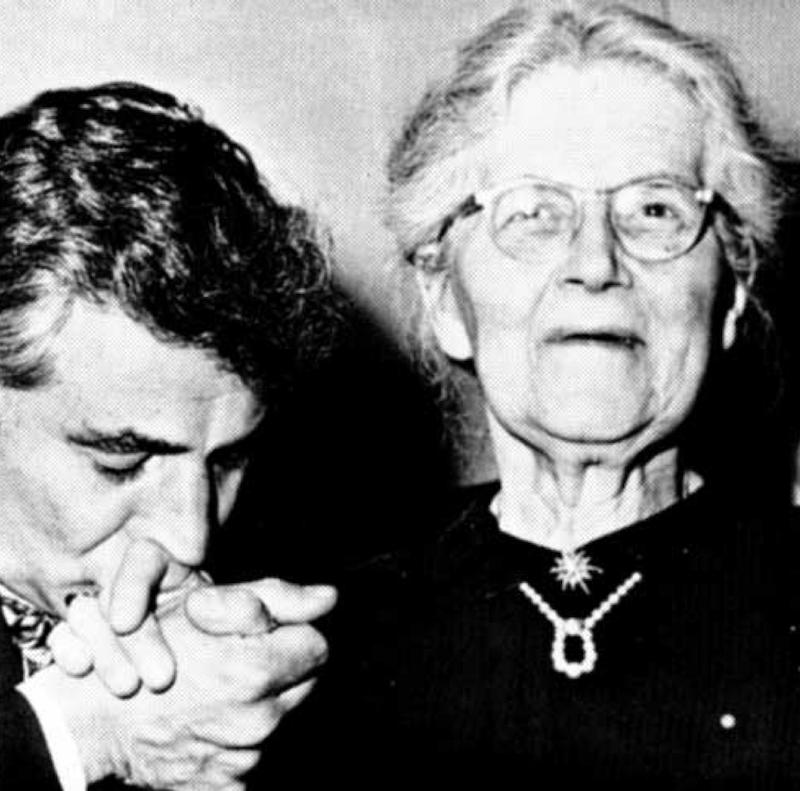
As a young man, Copland went to Paris in 1922, studying with the hugely influential teacher, Nadia Boulanger. He’d only planned to be there for a year, but stayed for three. It was tin Paris that he first met fellow American composers Virgil Thomson, Walter Piston, and Ned Rorem. He was swept up in the heady culture of Paris between the wars, hanging out at Shakespeare & Co. with the likes of Ernest Hemmingway, Gertrude Stein, Pablo Picasso, and Marc Chagall.

After returning to America he wrote in the thorny, modernist style that was expected at the time. But as the Depression approached he became more intellectually and emotionally involved in the socialism that was the rage among the left. By 1933 he began to find ways to make his stark musical language accessible to a surprisingly large number of people. Having encountered the move toward more populist music in Europe, he found a language for American music that reached out to the people. Pieces from the 1930s such as Appalachian Spring, Rodeo, and Fanfare for the Common Man define the American sound better than anything before or since, and have remained part of the repertoire to this day.

Ned Rorem wrote, "Aaron stressed simplicity: Remove, remove, remove what isn't needed...Aaron brought leanness to America, which set the tone for our musical language throughout [World War II]. Thanks to Aaron, American music came into its own."[ Born the son of Russian Jewish immigrants, he was Jewish, but only culturally. He was also gay, but kept it under wraps, as so many had to in those difficult times. He was called before McCarthy’s hearings, but stood firm in his opposition to militarism and the Cold War. When they tried to accuse him of being un-American, the musical community came to his defense. After all, how could the composer of Appalachian Spring be un-American? He defined the very soul of American music.
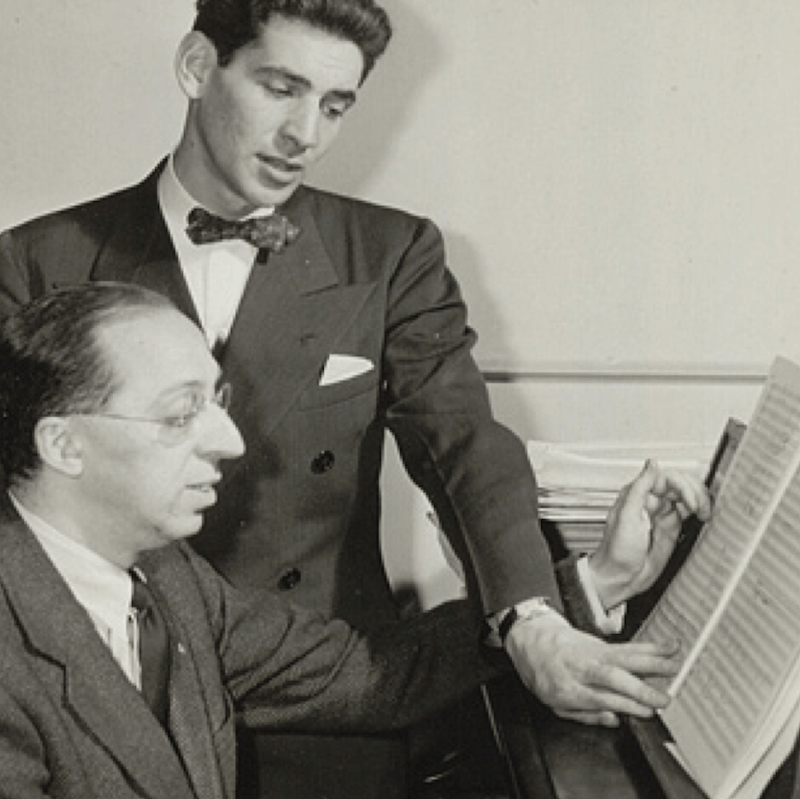
Later in his life Copland concentrated on conducting, mostly his own music and that of his contemporaries. Ironically, he turned to Lenny for coaching! In 1950, he published his first set of Old American Songs, followed by a second set two years later. (A gay history side-note: the first set was premiered by tenor Peter Pears, accompanied by his life partner, Benjamin Britten.) We sang “The Boatman’s Dance,” from the first set, in 2013, and this spring we’ll be performing three more: “The Dodger (Campaign Song)”, “The Little Horses (Lullaby),” and “Zion’s Walls (Revivalist Song).” Come join us for Lenny & Friends, and hear just how wonderful these songs are!
By Oakland GMC December 3, 2025
Voices from our Chorus David Guerra on Sewing Costumes, Singing Truths, and Finding Family  By June Kamerling
April 25, 2025
Voices from our Chorus Fred Rogers Reflects on His OaklandGMC Journey By June Kamerling
December 13, 2024
Conducting Change: A Chat with Bruce Southard, D.M.A.
By Oakland GMC June 1, 2024
Support the Oakland Gay Men's Chorus this Pride Month!
By Oakland GMC June 1, 2024
By Seth Frost (He/Him), Board Secretary, Baritone. As we welcome Pride Month, it's a time to reflect, celebrate, and honor the journey of the Oakland Gay Men's Chorus (OGMC). Our chorus was established in 1999, and since joining in 2018, I have been proud to be part of this vibrant community. From my very first interaction, I felt a warm embrace, an invitation to be part of something bigger than myself. For many, like myself, OGMC has been a core connection to the queer community, especially for those who came out later in life. Performing shows is more than a passion; it's our way of enriching the broader community in Oakland and the SF Bay Area, showcasing the joy found in queer life. At the heart of OGMC is our mission statement: "The Oakland Gay Men’s Chorus gives voice through song to a community where everyone matters." This guiding principle shapes everything we do. Being in a chorus means standing bravely in public, singing, supporting each other, and creating something more beautiful than any of us could achieve alone. This Pride Month, we're particularly excited about our 25th Anniversary Season, featuring "You Can’t Stop The Beat." This show is a showcase of our talents, with small ensemble and solo pieces prepared by our members. It's also a preview of the music we'll be taking to the national GALA festival in Minneapolis later this summer. Songs like "True Colors" are on the lineup, and I can't wait to see my friends shine. Celebrating Pride in Oakland and at the GALA Festival is especially significant this year. Our recent commission from Marques L. A. Garrett, requested by popular demand, highlights the collaborative spirit of our members. This show, filled with solos and special performances, is a true celebration of our talented membership. What does Pride mean to you? Seth Frost (He/Him), Board Secretary, Baritone. Pride is a call to step forward and assert that we matter, that our voices deserve to be heard. Pride events counteract hate and help heal the shame within ourselves. Singing loudly and proudly, we offer comfort and a beacon to those who can't yet express themselves authentically. Our year-round performances often end with the chorus spreading out around the audience, fostering a sense of community, welcome, and safety for all. June Kamerling (She/Her), Tenor 1 Pride is a celebration of the LGBTQ community and all it stands for. By participating in events like Oakland Pride and Alameda Pride, we give back to the community and practice visibility and inclusion. The impact of our events is profound, creating a supportive community where everyone feels they belong. Shawn Simon (He/Him), Board Vice President, Base Pride means being able to love ourselves unconditionally and seeing others empowered to live authentically. It's important to celebrate Pride to remind ourselves of our worth, connect with our community, and honor our history. Organizing events like our concerts has been profoundly impactful, creating an inclusive community and supporting local organizations.
March 24, 2024
By Melvin Terry  March 31st was declared Cesar Chavez Day in 2014 by President Barack Obama. Cesar Chavez (March 31, 1927 – April 23, 1993) founded along with Delores Huerta the National Farm Workers Association (NFWA), which later merged with the Agricultural Workers Organizing Committee (AWOC) to become the United Farm Workers (UFW) labor union . International Women’s Day was first celebrated in the early 20th century and became a mainstream global holiday in 1977. It helps to focus attention on women and concerns such as gender equality, equal wages, and violence and abuse against women. Another important issue is the lack of attention paid to the substantial contributions of women.
February 20, 2024
By Melvin Terry Oakland is a diverse vibrant community with a goldilocks climate and an assortment of parks and trails with opportunities for exercise, socializing, and stunning visuals. It also has the benefits and drawbacks that come with a large city. But did you know about the history of Black migration to Oakland in the 1940’s and the rich culture that flourished in West Oakland back then? 7th Street, now the home of West Oakland BART and the sprawling main post office, was the hub of the community. There were many Black owned businesses and music venues. It was bustling and the place to be.
December 25, 2023
By Melvin Terry It doesn’t seem so long ago when I first heard of GALA (GayLa), a sort of choral Olympics where queer folks from around the world get together every four years to celebrate our existence and joyously sing for each other. Well, it was 16 years ago, when I first joined the then Oakland East-Bay Gay Men’s Chorus in 2007.
More Posts