

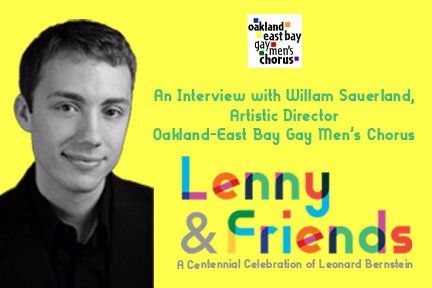
The Artistic Director of the Oakland East Bay Gay Men’s Chorus, William Sauerland (known to the chorus as Billy), easily expresses his passion for the music of the 2018 spring concert, Lenny & Friends: A Centennial Celebration of Leonard Bernstein
. His emotional connection to the music on the program stems from early childhood when he immersed himself in the music of the stage—both musical theatre and opera. One of the first shows he remembers listening to was West Side Story
. As a child, he knew it was escapism; it was not until he was a teenager that he began to understand that West Side Story
along with much of Bernstein’s work pointed a truth at life as a response to oppressive ideologies and social injustice.
Bernstein, Billy said, was first and foremost a conductor. Bernstein was also a great composer, and his music is part of the quintessential sound of the 20 th century musical theatre and even classical music. This was the starting place for the program—Bernstein at 100, and who influenced Bernstein, who was influenced by Bernstein, and how is his music still influencing composers.
Bernstein was gay, along with all the other composers on this program except for Edward MacDowell (“Midsummer Clouds”). (Yes, Bernstein was married to a woman and had three children with her; he also had many male lovers whom she knew about). sBilly feels that OEBGMC, an LGBTQ arts organization, has a responsibility to perform queer music. While singing some well-known music, the chorus is also exploring and performing music that few other groups may take on. Some of these pieces make the program both musically and emotionally difficult—some of the texts will have deep resonance with the performers and the audience--and Billy has a sense of responsibility for this music. He said that this music gives all of us a chance, not just to engage music as a form of entertainment, but to pause for reflection on what truth the art is pointing out.
Bernstein and his friend and fellow conductor/composer Aaron Copland (OEBGMC is performing “The Dodger,” “The Little Horses,” and “Zion’s Walls”) were at the upper echelon of composers, and they worked with excellent musicians to try these new musical styles. Their music is such a part of the American musical fabric that, because it is so recognizable, Billy said, it gives a weird feeling of being accessible; however, their music is challenging. Bernstein and Copland used a level of difficulty in their music in order to serve the text. While Copland captured rural Americana, Bernstein captured the rhythm and sounds of urban life, especially New York City.
In much of Bernstein’s music, the place—the setting—is as important as the text and music. New York City is prominent in West Side Story , as well as On the Town (about 3 sailors on leave in NYC before heading off to WWII), and Wonderful Town (about two sisters who leave their home in Ohio to make their way in the Big Apple) . Billy said that while some may claim that On the Town had a better musical score, he prefers Wonderful Town because there is something universal in leaving home. In the song, “Ohio” the sisters wonder, “Why did I ever leave Ohio?” (Check out a funny scene starring Rosalind Russell here .) Billy grew up on a dairy farm in western Ohio, and he has sung this song often in duet (he has a beautiful counter tenor voice!). Although he now has more emotional attachment to the singers with whom he has performed than to the sentiment of the song, and even though he has no intention of ever moving back, he can’t say that the longing to return to Ohio will ever go away. As a musician from Ohio, New York City was itself a draw, the place to go. He got to NYC for the first time when he was a senior in high school, and he said he had the feeling it was where life was happening. He has made his home in the San Francisco Bay Area, and there is something appealing, he said, about New York.
Bernstein wrote many pieces for the times. His Mass , from which OEBGMC is singing “Gloria Tibi”, was written in response to the death of President John F. Kennedy; the musical 1600 Pennsylvania Ave. , which later was reworked into the White House Cantata , was written for the 200 th anniversary of the US; it was also a response to Watergate. It is from the White House Cantata that OEBGMC is singing Billy’s favorite song on the concert, “Take Care of This House.” It is combined with “My House” from Bernstein’s version of Peter Pan, and the two house songs call for a house to be built of love and truth and peace, and to keep the dreams of the people alive. The moving text is a response to what our country is going through and a plea to the current inhabitant of 1600 Pennsylvania Ave to take care of OUR house.
Billy said that after exploring Bernstein, he wants to explore the works of one of the other composers on this program, Pulitzer winner Ned Rorem, who has piqued his interest. Billy is in love with the song “Love Alone,” which is sung by a small ensemble of chorus members. The text, from the poem “Here” by Paul Monette, reveals the agony of a man who has lost his lover to AIDS, and Rorem set it to music as a tribute to all who died of AIDS, reminding us, like Lenny and his Friends, that art can be both beautiful and political.
In response to the assassination of President Kennedy, Bernstein wrote, “This will be our reply to violence: to make music more intensely, more beautifully, more devotedly than ever before.” After the 2016 election, feeling lost and confused, Billy wondered what he could do. His answer--make music, be out, be queer. He put the quote, “This will be our reply…” on his mirror and read it every morning for inspiration, unaware of the source. One day while driving he began singing the words, in a chant reminiscent of Gregorian chant, the yoga he used to practice, and a Catholic prayer his grandmother used to sing. He pulled over and recorded it on his phone. He then set the music, and then sought the source. With Bernstein’s text, Billy’s “This Is Our Reply: A Meditation” premiers with this program and opens the concert. It offers symmetry to the first half of the program that closes with the chant-like “Let Us Plant Our Gardens Now,” by the young modern composer, Dominick Diorio.
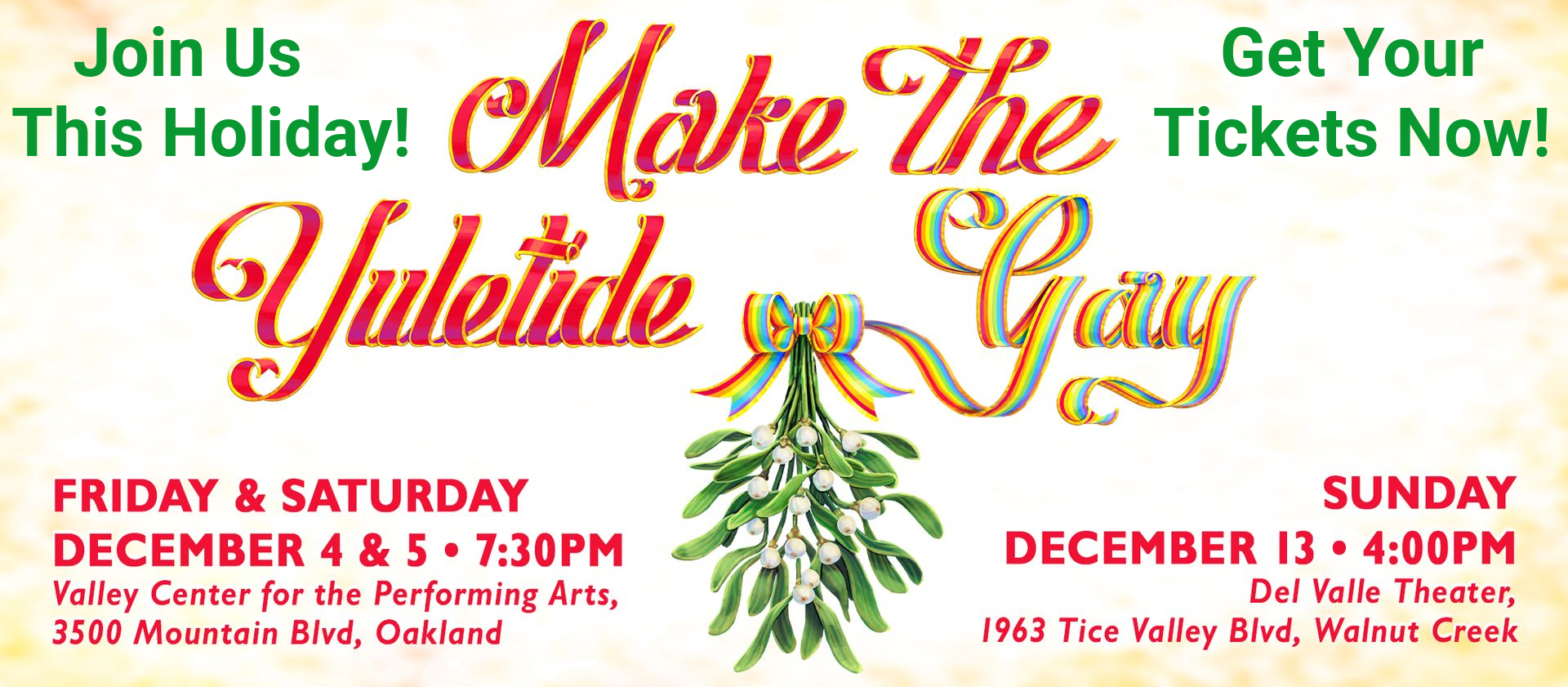
This concert is the reply of the Oakland East Bay Gay Men’s Chorus to our time: to make music more intensely, more beautifully, more devotedly than ever before. Please Join OEBGMC, and Artistic Director, William Sauerland, on April 7 @ 7 pm, Lafayette Christian Church; April 14 @ 7 pm, Montclair Presbyterian Church; or April 8 @ 5 pm, First Congregational Church of Alameda. Get your tickets here .