Third in a series. Link to the second article in the Lenny Bernstein series.

"If my music has been connected in people's minds with America, if people find some reflection of the American spirit in my music, then certainly the Colony must have some of the credit."
—Aaron Copland, in his acceptance speech on Medal Day at the MacDowell Colony, 1961.


That’s right…

“So, how’s a guy that died, what, 10 years before Lenny was even born get to be in the concert?”

That’s a good question. And the answer involves a trip to Paris, a glee club, an abandoned farm in New Hampshire that turns into an artists’ colony, a horrible taxi accident, and a gold medal that Lenny was given. But we’re getting ahead of ourselves…

The American pianist and composer, Edward MacDowell, was born in 1860 in New York City. Since there weren’t opportunities for American-born composers at home, his mother took him to Europe when he was 17. He enrolled at the Paris Conservatory on a scholarship for foreign students, where he studied alongside Claude Debussy. It was there that he played a piano recital for Franz Liszt and Clara Schumann, who considered him a major talent. He stayed in Europe, teaching and performing, for several years. In 1884, he married a former American student of his, Marian Nevins, whom he’d taught in Frankfurt. She ends up playing a big part in this story.

They returned to America in 1888, and in 1896 he was asked to be the very first music professor at Columbia, where his task would be to create a Music Department virtually from scratch. For his first couple of years there he led the Mendelssohn Glee Club, and wrote several pieces for them. (One of those songs will be on our program.) He left Columbia in 1904, leaving in a huff after a nasty row with the new President.

Meanwhile, Marian knew that her husband needed a quiet place to compose. She found an abandoned farm on 80 acres in rural New Hampshire. They bought Hillcrest Farm, and made it their summer home. After being shown the door at Columbia, Edward fell into a depression, and his health deteriorated. Later that same year, 1904, he was run over by a hansom cab on Broadway, injuring him seriously and contributing to his advancing psychiatric disorder. His former students from the glee club led a campaign to raise money for his care. In 1907, the MacDowells deeded the farm to the newly established MacDowell Colony, the first artists’ residency program in America. Edward died in 1908, at age 47, and is buried at the Colony.

At the time of his death he was regarded as a great American composer with an international reputation. That reputation has diminished in the ensuing years, and now he’s known mostly for piano miniatures such as “To a Wild Rose,” surely his most famous composition. Bernstein conducted several of his orchestral pieces in his early years with the New York Philharmonic. (His Second Piano Concerto used to be played frequently; it deserves a revival!) Marian outlived her husband by almost 50 years, and was regarded as the foremost champion of his music, and of the Colony.

Since 1908 the MacDowell Colony has proven to be a priceless gift to American artists. Its resident fellows read like a who’s who of American arts, including authors Thornton Wilder, James Baldwin, Willa Cather, and Alice Walker. In music, the list has Aaron Copland (who wrote Appalachian Spring there,) Amy Beach, Virgil Thomson, Walter Piston, Samuel Barber, and Leonard Bernstein, who completed Mass there, in 1970. To bring it closer to home, Berkeley writer Michael Chabon finished The Amazing Adventures of Kavalier & Clay at the MacDowell Colony, and currently serves as the President of its Board of Directors.


In 1960, the Colony established the Edward MacDowell Medal, awarded annually for distinguished contribution to American arts and culture. Wilder won the first award; Copland, the second; Robert Frost, the third. Leonard Bernstein won the MacDowell Medal in 1987, and Steven Sondheim in 2013. Bernstein remarked that it was the first award he had received solely for his compositions. “Medal Day” is a major event at the Colony, with a huge tent for the presentations, along with picnics and tours of the 32 artist’s studios. From the beginning the ceremony has included an address by an equally worthy artist about the recipient. When Lenny received the award, the speaker was his old friend, the composer and diarist, Ned Rorem. We’ll have more to say about him in another article.

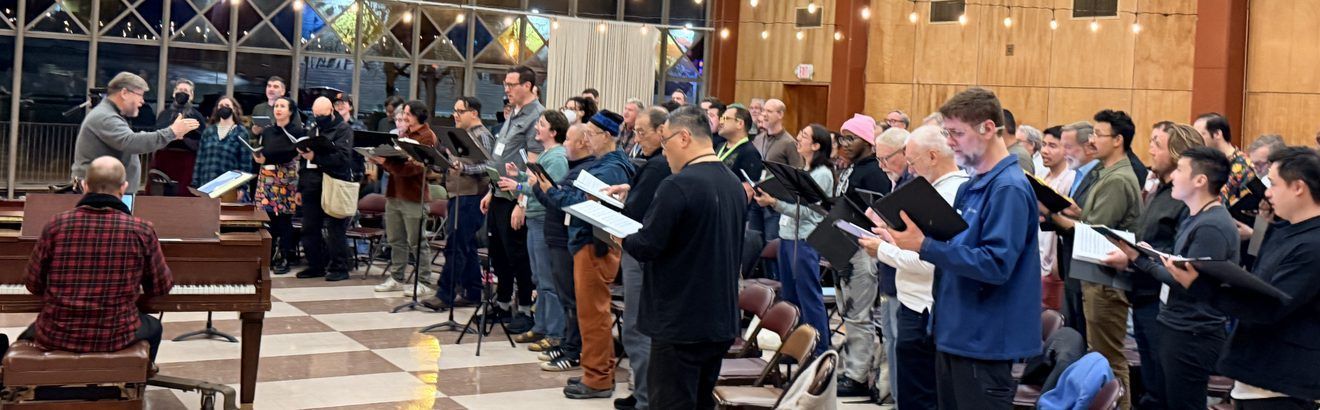
Oakland East Bay Men's Chorus is excited to be paying our small tribute to this true patron saint of the American arts. The MacDowell song that we’re performing is “Midsummer Clouds,” published in 1898, and written for his own men’s chorus at Columbia. It’s a lovely, literally dreamy, reverie; an American form of Impressionism akin to what he’d encountered in Paris, complete with exotic scales, parallel movement, and time seeming to stand completely still.

This is a concert not to be missed!
By Oakland GMC December 3, 2025
Voices from our Chorus David Guerra on Sewing Costumes, Singing Truths, and Finding Family  By June Kamerling
April 25, 2025
Voices from our Chorus Fred Rogers Reflects on His OaklandGMC Journey By June Kamerling
December 13, 2024
Conducting Change: A Chat with Bruce Southard, D.M.A.
By Oakland GMC June 1, 2024
Support the Oakland Gay Men's Chorus this Pride Month!
By Oakland GMC June 1, 2024
By Seth Frost (He/Him), Board Secretary, Baritone. As we welcome Pride Month, it's a time to reflect, celebrate, and honor the journey of the Oakland Gay Men's Chorus (OGMC). Our chorus was established in 1999, and since joining in 2018, I have been proud to be part of this vibrant community. From my very first interaction, I felt a warm embrace, an invitation to be part of something bigger than myself. For many, like myself, OGMC has been a core connection to the queer community, especially for those who came out later in life. Performing shows is more than a passion; it's our way of enriching the broader community in Oakland and the SF Bay Area, showcasing the joy found in queer life. At the heart of OGMC is our mission statement: "The Oakland Gay Men’s Chorus gives voice through song to a community where everyone matters." This guiding principle shapes everything we do. Being in a chorus means standing bravely in public, singing, supporting each other, and creating something more beautiful than any of us could achieve alone. This Pride Month, we're particularly excited about our 25th Anniversary Season, featuring "You Can’t Stop The Beat." This show is a showcase of our talents, with small ensemble and solo pieces prepared by our members. It's also a preview of the music we'll be taking to the national GALA festival in Minneapolis later this summer. Songs like "True Colors" are on the lineup, and I can't wait to see my friends shine. Celebrating Pride in Oakland and at the GALA Festival is especially significant this year. Our recent commission from Marques L. A. Garrett, requested by popular demand, highlights the collaborative spirit of our members. This show, filled with solos and special performances, is a true celebration of our talented membership. What does Pride mean to you? Seth Frost (He/Him), Board Secretary, Baritone. Pride is a call to step forward and assert that we matter, that our voices deserve to be heard. Pride events counteract hate and help heal the shame within ourselves. Singing loudly and proudly, we offer comfort and a beacon to those who can't yet express themselves authentically. Our year-round performances often end with the chorus spreading out around the audience, fostering a sense of community, welcome, and safety for all. June Kamerling (She/Her), Tenor 1 Pride is a celebration of the LGBTQ community and all it stands for. By participating in events like Oakland Pride and Alameda Pride, we give back to the community and practice visibility and inclusion. The impact of our events is profound, creating a supportive community where everyone feels they belong. Shawn Simon (He/Him), Board Vice President, Base Pride means being able to love ourselves unconditionally and seeing others empowered to live authentically. It's important to celebrate Pride to remind ourselves of our worth, connect with our community, and honor our history. Organizing events like our concerts has been profoundly impactful, creating an inclusive community and supporting local organizations.
March 24, 2024
By Melvin Terry  March 31st was declared Cesar Chavez Day in 2014 by President Barack Obama. Cesar Chavez (March 31, 1927 – April 23, 1993) founded along with Delores Huerta the National Farm Workers Association (NFWA), which later merged with the Agricultural Workers Organizing Committee (AWOC) to become the United Farm Workers (UFW) labor union . International Women’s Day was first celebrated in the early 20th century and became a mainstream global holiday in 1977. It helps to focus attention on women and concerns such as gender equality, equal wages, and violence and abuse against women. Another important issue is the lack of attention paid to the substantial contributions of women.
February 20, 2024
By Melvin Terry Oakland is a diverse vibrant community with a goldilocks climate and an assortment of parks and trails with opportunities for exercise, socializing, and stunning visuals. It also has the benefits and drawbacks that come with a large city. But did you know about the history of Black migration to Oakland in the 1940’s and the rich culture that flourished in West Oakland back then? 7th Street, now the home of West Oakland BART and the sprawling main post office, was the hub of the community. There were many Black owned businesses and music venues. It was bustling and the place to be.
December 25, 2023
By Melvin Terry It doesn’t seem so long ago when I first heard of GALA (GayLa), a sort of choral Olympics where queer folks from around the world get together every four years to celebrate our existence and joyously sing for each other. Well, it was 16 years ago, when I first joined the then Oakland East-Bay Gay Men’s Chorus in 2007.
More Posts